lifestyle

Three things I’ve learned from children about movement

Three things I've learned from children about movement

On my fitness journey, I’ve had the privilege of learning from many wonderful people. I am often surprised by the wealth of wisdom and knowledge that we hold, and can share with one another. Nothing, however, surprised me more than what fantastic teachers children are, in the art of movement and body confidence.

Here are 3 key lessons that children have taught me so far!

It’s not about how the body LOOKS

When a baby is developing the core strength to hold themselves up, or a toddler is using all available furniture to climb up to a tin of biscuits, or a 5 year old is climbing up a huge wall using a rope, they are NOT concerned with how their body LOOKS. Nor are they motivated by whether that particular motion will tone a specific part of their body. They are completely focused on what they want their body to DO, and they put all of their physical energy into achieving it. There is absolutely no concept of making themselves ‘look’ better, and this enables freedom and abandon as they explore the world.

To a child, the body is a vessel, one that is fun to explore with, and to USE. Somehow we lose that sense as we get older. The body becomes about the external, the aesthetic. We forget how to embrace it’s power to learn, how to appreciate the way that it deepens our experiences, and how to live through it. Seeing the relationship that a child has with their body is a wonderful lesson in how to embrace being alive through physicality.

If at first you don’t succeed….Try again. And Again. And Again!

One of the things I admire about really young babies is their ability to keep on trying the same thing, over and over. For example, when my daughter was tiny and learning to crawl, she would go through an entire lifetime of emotions in a few minutes. She’d be focused, then frustrated, then exhausted. Hopeful, inconsolable, and most of all.. TENACIOUS. She wouldn’t give up! She would ride the wave of emotion rather than fight it and the rewards are clear. She is now a walking, talking, running, climbing, tantrumming toddler!

As adults, we tend to want to get things ‘right’ first time. We are brought up on the notion that perfection is aspirational. If you can be ‘perfect’ quickly, you’re somehow innately talented. You’re superior to someone who has to toil to learn something. The truth is, if we had those egotistical ideas as babies, none of us would get anywhere. We’d paralyse ourselves into inaction with self criticism, because there isn’t a baby on Earth who is born and gets up and just starts walking!

There is a wealth of positive experience, and reward, in the PROCESS of learning. Kids remind me of that every day.

Our bodies are FUN

Have you ever been around a baby who spends AGES lying on a playmat, trying to hit the singing cloud that’s hanging down? Or a toddler who will NOT sit down because they keep on trying to climb up onto a chair to reach something that they want? Or a 5 year old who climbs up the same rope ladder 10 times without a rest and won’t stop? Kids appreciate the enjoyment that their bodies give them. They don’t mind being out of breath, or taking a risk, or experimenting. They get frustrated when they can’t do something, but they don’t let it stop them. They find it too damn tempting to get up and try again because it feels so GOOD to move!

Kids appreciate their bodies and know how to love them. They USE them, rather than judge them.

Disclaimer

So, there you have it! 3 lessons that I’ve learned from hanging out with kids. As a disclaimer, though, I’m not suggesting for a minute that it isn’t kind of annoying when you want to settle down with a Netflix show after a long day and your toddler wants to play the ‘I’m going to climb something REALLY dangerous’ game 😊 But, they do have a lot to show and teach us about how to really enjoy and use our bodies, in a way that we seem to have forgotten. I'm very grateful for having a little human being around as a free movement teacher!

To your body confidence!


"There is a wealth of positive experience, and reward, in the PROCESS of learning. Kids remind me of that every day."

Posted by Taj Kandula - Scott in Inspiration, Lifestyle, Philosophy, 0 comments

Why Shouldn’t I Weigh Myself?

Why Shouldn't I Weigh Myself?

Quite simply, it’s not a proper measure of your fitness, wellness, or health. Weight loss is one of the most common aspirations that I come across, but I actively encourage my clients to avoid the scale. Here are three reasons why.

1. Lighter isn’t always healthier

It’s really simple. Dropping pounds on the scale is NOT a sign that you are getting fitter. The measure of your progress is how you feel, the quality of the choices that you’re making, and the power that you are giving yourself to become the person that you want to be by digging deep. It is not whether you sit at a certain level on the BMI scale.

2. There is no such thing as an “ideal” weight.

So many people want to reach a particular weight, or lose a certain amount, because somehow that will mean that they suddenly feel better about themselves. The simple fact is, you can lose lots of weight taking unhealthy measures, such as not eating, or drinking juice all day every day, but you will not feel good in yourself for it. Before you know it, you will put the weight back on, and you will feel terrible for letting yourself gain weight.

There is nothing to gain from obsessing over reaching an “ideal” weight. There is no such thing. Life just isn’t that simple. YOU aren’t that simple!

3. Weight doesn’t account for natural fluctuations

Your body is going through a raft of fluctuations on a regular basis. Women are continually going through hormonal changes that cause water retention, bloating, and general dips in particular neurotransmitters in some cases, and these can all lead to weight fluctuation on the scale. You can immediately set your confidence back by weighing yourself on a day where your hormones are changing, or you are retaining water from a meal. Equally, if you haven’t pooped…. It will make a difference!

There are plenty of ways to measure your progress that don’t involve the scales. Taking measurements is a good way to keep track of real changes in your body shape. As you get fitter and healthier, it’s very likely that you will drop clothes size, and having an item of clothing that you can try on every 6 weeks can also be a good way to enjoy tangible change.

The key thing is how you FEEL. Feeling that you are making the right choices for both your mind and body. Feeling that you are proud of who you are; someone who makes a decision to make positive change, and bravely sees that journey through. Feeling that you are the person that you want to be.

Free yourself from the scale! It isn't the measure of your worth!

To your success 🙂


Scales, weight loss, new year goals

"The key thing is how you FEEL. Feeling that you are making the right choices for both your mind and body. Feeling that you are proud of who you are; someone who makes a decision to make positive change, and bravely sees that journey through. Feeling that you are the person that you want to be. "

Posted by Taj Kandula - Scott in Philosophy, 0 comments

Making Space: The Power of Intention

Making Space: The Power of Intention

We all have busy lives. The demands placed on that most valuable commodity – Time – are getting increasingly pressured and unrealistic, and we spend much of our time frantically prioritising the various obligations that we have to fulfil.

Something has to give. If we don’t consciously intend to make space for something, it will be pushed to the bottom of the pile, and eventually forgotten. Often, the things that are pushed to the bottom of the priority pile are the things that are focused on ourselves; the novel we’ve always wanted to write, the art class we’ve wanted to join, the exercise regime we’ve been thinking about...

It’s easy to lose sight of these aspirations in the pace of the daily grind, and without realising it, our lives become a series of obligations. We don’t realise it consciously; we simply carry on, an inexplicable sense of dissatisfaction lingering, until we’ve forgotten what we actually want to do, and can’t quite understand why we’re feeling a bit rubbish.

It’s easy to sail through life without setting intentions. Which is a shame, because when you do, you find yourself making space for the things that you actually WANT to do – the things that are focused on you and your wellbeing. Gradually, that lingering feeling that your life isn’t your own fades. You regain a sense of control over your life.

It’s important to set conscious intentions. Without them, it is almost impossible to sustain any activity, however well intentioned. More pressing, short term obligations will always take precedence, and although you know that your workout will feel good, yield amazing results and most importantly, is time for you, and you alone, you are always likely to fall prey to the many demands that life puts on you, neglecting yourself and your own needs in the process.

The challenge of exercise is, first and foremost, the challenge of adherence. Of making space for it in the landscape of your life. Of prioritising yourself and your own wellbeing. Set the conscious intention to put yourself first, and to make space for exercise. It’s the first step to integrating exercise into your life, and, before you know it, it will be an immovable part of the various components of your lifestyle.

Make the conscious decision to give yourself priority a few times a week to reconnect with your body. Set the intention. Let yourself come first! You’ll be amazed at the progress you make.


Road saying start

"Make the conscious decision to give yourself priority a few times a week to reconnect with your body. Set the intention. Let yourself come first!"

Posted by Taj Kandula - Scott in Exercise, 0 comments

A Simple Guide to Setting Effective Goals

A Simple Guide to Setting Effective Goals

Setting effective goals is an essential part of getting yourself mentally prepared for a lifestyle change. It’s easy to jump back into exercise and changing your dietary habits without taking the time to consider why, and often this means that you fall off the wagon sooner rather than later. Goals are fantastic reminders of what you want to achieve, and can be used to keep you on the right track when your mind starts trying to make excuses (i.e. convincing you to stay at home and binge watch The Crown on Netflix rather than do your workout!). Sometimes it's difficult to know where to start, so here is a simple guide to setting effective goals to get you started. 

If you still need convincing about why setting goals is important, click here. If you’re raring to go, keep reading!

Step 1: Brainstorm

Let yourself think very freely about why you want to get fit and healthy. Be completely honest with yourself and scribble out anything and everything that comes to mind. Are you embarrassed by your weight? Frustrated by feeling out of breath all the time? Looking for help with regulating your energy levels? Are you hiding behind baggy clothes and not pursuing your dreams because you feel trapped inside your body? Perhaps you want to be able to eat and feel good about it rather than feeling guilty all the time. We are complex creatures, with lots of stuff going on, so let yourself freestyle here. Don’t be surprised if this is an emotional process. We aren’t often encouraged to really take the time to notice how we feel, and why we might be feeling that way. Sometimes it’s a shock to the system.

Step 2: Isolate key items

If you have completed the above step, you probably have a sheet (or maybe a few!) of paper with scribbles or a long list of thoughts about why you want to get healthy. The next stage is to go through what you have scribbled out in your brainstorm, and highlight which ones feel the most pressing at the current time. Which issue is REALLY bothering you on a day-to-day basis? Pick 3 things at a maximum. Don’t throw the brainstorm away. Keep it in a drawer, ready to refer to when it’s time to set new goals.

Step 3: Create specific goals

It’s time to take your chosen items and create 3 well-defined goals. Think of them as crystallisations of what you want from your health and fitness regime, and why you are making this change. If this feels difficult, it’s a sure sign that this is a vital part of the process for you. It’s far easier to stick to things when you know why you are doing them! If you don’t know why you’re making loads of effort, and don’t have a strong sense of where it’s all leading, you’re bound to struggle. You need that sense of direction to keep you motivated!

You may have heard of SMART goal setting. There are endless articles about this, and it’s a very effective way of making sure that your goals are going to keep you on track when you feel life and it’s many challenges weakening your resolve.

Here are the key aspects of any goals that you set, according to the SMART model:

Specific – your goals need to state, very clearly, what you are striving to achieve. Anyone who reads your goals should be able to understand what your aims are with no ambiguity. If you have a crystal clear picture of what you are aiming for, you are more likely to get there. If you don’t know where you’re heading, you will struggle to keep yourself motivated. You won’t ever know that you’re on the right track, or be able to remind yourself of why it’s worth the effort.

Measurable – we are pleasure seeking creatures. We like to feel good in ourselves. We particularly like to feel a sense of achievement. Clear, indisputable evidence that our effort and hard work is paying off is a guaranteed way to create the feel good factor that will keep you going in difficult times. A goal should be easy to track and measure. The tangible sense of progress will keep you on track.

Achievable – you want to set yourself up for success. Goals shouldn’t be too easy, but if you are over – ambitious, you are likely to give up because the goal seems so far away. You want your goals to be within your reach, so that you can visualize achieving them. Setting unachievable goals will hinder you because you won’t be able to “see” your success in your mind’s eye. That visualization is a key element of your success. This is also the time to consider whether you need any external aid – you may feel that a trainer can help by writing a plan tailored to your goals. Here’s an article to help you find the right trainer if you decide to go down that road.

Relevant – goals are designed to keep you on track, and keep you motivated. It needs to be easy to see how the achievement of this goal is going to positively impact your life. It can be as simple as wanting to be able to run for the bus without feeling winded, or being able to play with the kids at the park without feeling self conscious about being overweight. There are no right or wrong goals – the trick is to take the time to think about what is actually relevant to you in the context of your life and situation.

Time bound – when you set a goal, set a time frame. If your goal is to be able to run 5k, but you don’t set a time frame for it, you aren’t giving yourself any impetus to get started, or to stick to it. If you set a goal to run 5k in 3 months, you are far more likely to stick to your exercise plan because you have a deadline to aim for.

Apply these 5 elements to your 3 goals. Once done, write the goals out over and over again. Take your time with this process, and let yourself do it properly. Trust me, it’s worth the effort!

Step 4: Embed your goals 

Now, you have 3 strong goals written down. You have taken the time to transform muddy concepts and ideas into crystal clear statements of intention. You have begun the process of embedding those goals in your mind by writing them over and over. Now, it’s time to move towards completing the process.

Write your 3 goals out onto index cards, or onto post – it notes, and put them somewhere that you will see them frequently. Keep reminding yourself of them, and say them to yourself at night just before falling asleep. Do this for at least 3 days before you start a new eating or exercise plan. Hold yourself back for a short while, and use that time to mentally cement your intentions.

Phew, once you’ve done all of this work, you’ll be raring to go! Enjoy discovering your body confidence! 🙂 

P.S If you need a few tips on getting started on your fitness journey, my e-book, “Getting Started” is free to download. Click HERE to subscribe to my mailing list (no spam, I promise!) and download your free copy 🙂

woman walking looking at map

"If you don’t know why you’re making loads of effort, and don’t have a strong sense of where it’s all leading, you’re bound to struggle. You need that sense of direction to keep you motivated!"

Posted by Taj Kandula - Scott in Lifestyle, 0 comments

Dare to be different

Dare to be different - love yourself

In today’s world, we’re born into an inescapable social system where judging the human body is the norm. We are a society obsessed with how our bodies look. Social media has created a platform for us to judge each other and pass comment, and actively encourages us to broadcast ourselves and measure our self worth in terms of how many likes we get on Facebook in response to our latest profile picture, or how many followers we have on Instagram. It takes a lot of courage and strength to dare to be different, and to refrain from negative self judgement, or the judgement of others. 

From the moment that we come into being, we observe and absorb the stimuli surrounding us on both a conscious and subliminal level. On one hand, this is a wonderful thing; the capacity to learn and absorb so much through our senses is part of what makes us the amazing creatures that we are. But, if what we are taking in is riddled with negative imagery and messages that encourage unrealistic expectations of ourselves, it can lead to negative outcomes.

Nowhere is this more apparent, in my view, than in our confused ideals around our bodies.

We are encouraged to look at our bodies as manifestations of our social worth in the world. The value of the body is often reduced to the external. The prevalent questions we ask ourselves are not around the issue of how well our bodies function and move, or how we can look after them, but how well they match up to the images that you see in the popular media.

“If only I had a body like that”, we say, looking wistfully at the imagery of so – called perfection that we see on the cover of the latest magazines, or on our Facebook feed, “I would love my body. My life would be wonderful.”

Except, it wouldn’t be. You wouldn’t feel better about yourself. As soon as another fabricated “ideal” of the perfect body is created by the media, you will feel completely inadequate again. And, here’s news for you – that “perfect” model you were looking at so wistfully? They will be feeling inadequate too, because their spell in the artificial warmth of the media sun has ended, and their body is no longer beautiful enough. It’s tragic. The whole system is designed to make sure that we all feel rubbish about our bodies, so that we’ll keep aspiring to something else. We’re rarely encouraged to truly step back, develop a relationship with our bodies, and to love them. There are fringe movements, claiming that they are all about empowerment, but even these can be purely based on the aesthetic. Proponents of a well intentioned “Love Your Body” movement can still be advertising their 6 pack abs and defined biceps in carefully angled photos posted on Instagram, potentially making others feel inadequate in comparison. It’s a difficult system to escape.

Our bodies ARE beautiful, yes, and exercise can help us to maximise our natural, aesthetic gifts, but far more importantly, our bodies are incredible vessels which allow us to do wondrous things. Things that we have come to take for granted. They allow us to experience the wonders that nature offers us. They allow us to play. To dance. To LIVE. How often are we encouraged to stop and really thank our bodies for keeping us alive? For working tirelessly, 24 hours a day, 7 days a week for decades to keep our hearts beating? For allowing us to experience life through our senses? In contrast, how often are we encouraged to shame ourselves, to subject our bodies to a barrage of experiments testing cosmetic products, fad diets, and punishing exercise regimes just so that we will conform to some arbitrary ideal of human beauty? Try watching an advert break and really pay attention to the messages that each advert is sending you. I’m positive that you won’t see a single one that encourages you to simply appreciate yourself. Why would you? That’s not a product. It doesn’t make money. If you were happy with your skin, your face, your hair, your body, your life, you wouldn’t need to buy anything to make you feel better about it. The first step to selling is to make you feel like you don’t match up to an ideal so that you'll consider buying whatever is being sold to get you closer. It’s cruel.

When the barrage of media stimulation that surrounds us is so relentless, it is challenging to take a step back and consider what our bodies actually are. We are taught from a worryingly young age that the value of the body in society is based more on how the body looks, than what it does.

The body allows us to experience life through our senses. Everything we feel, we feel through our bodies. When we embrace that, appreciating it for that rather than simply focusing on how it looks, and develop our relationship with our physicality in a loving, nurturing way, we begin to radiate beauty. True beauty, that shines from the inside out. Beauty that will stand the test of time, and the ever changing fads of fashion, because it’s not about what anyone else has ordained as beautiful. It’s your true beauty, and no one else’s.

It’s hard work, undoing old ways of looking at yourself and creating a new relationship with your body, but you will be stunned by the liberation that you experience when you are free of old habits, and learn to appreciate your body for the wondrous miracle that it is.

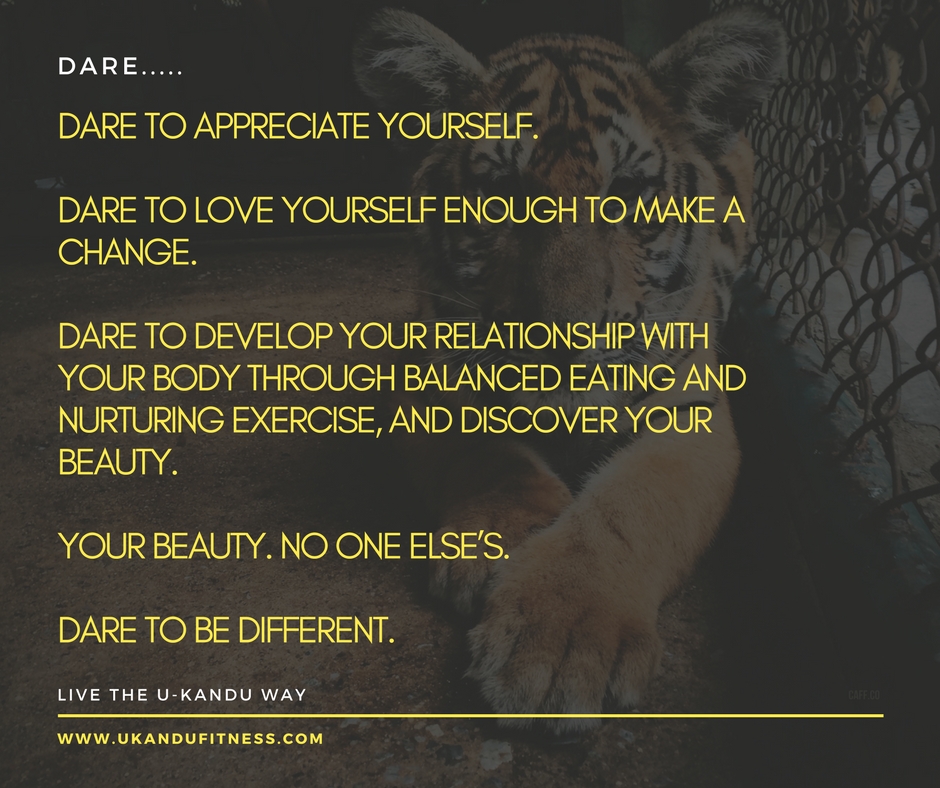
Your worth is not defined by what apps, adverts, or mob movements spread via social media decide. Your worth is decided by YOU. Next time you stand in front of the mirror and speak to yourself negatively, remind yourself of how hard your body is working for you, and dare to appreciate yourself. Dare to love yourself enough to make a change, to develop your relationship with your body through balanced eating and nurturing exercise, and discover your beauty. Yours. No one else’s. 

Dare to be different.

tiger behind text saying dare to appreciate yourself

"The prevalent questions we ask ourselves are not around the issue of how well our bodies function and move, or how we can look after them, but how well they match up to the images that you see in the popular media."

Posted by Taj Kandula - Scott in Philosophy, 0 comments